SNDdeN@UN’s report on Climate Change Summit
March 18, 2026
At the 30th session of the Conference of the Parties (COP) in Belém, Brazil, Nov. 10–21, 2025, nations gathered to discuss action on climate goals, specifically aiming to limit global warming to 1.5°C, ten years after the landmark Paris Agreement.
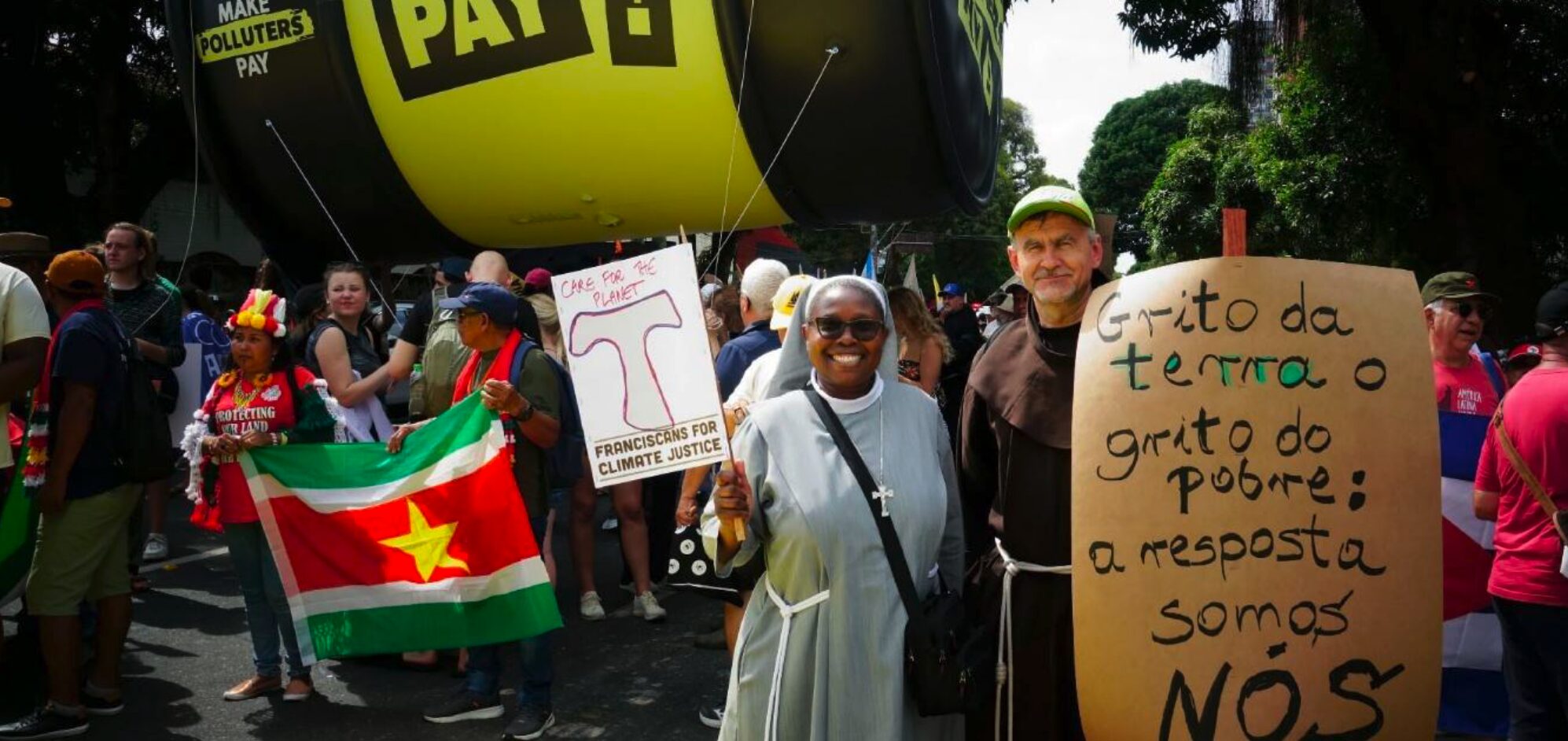
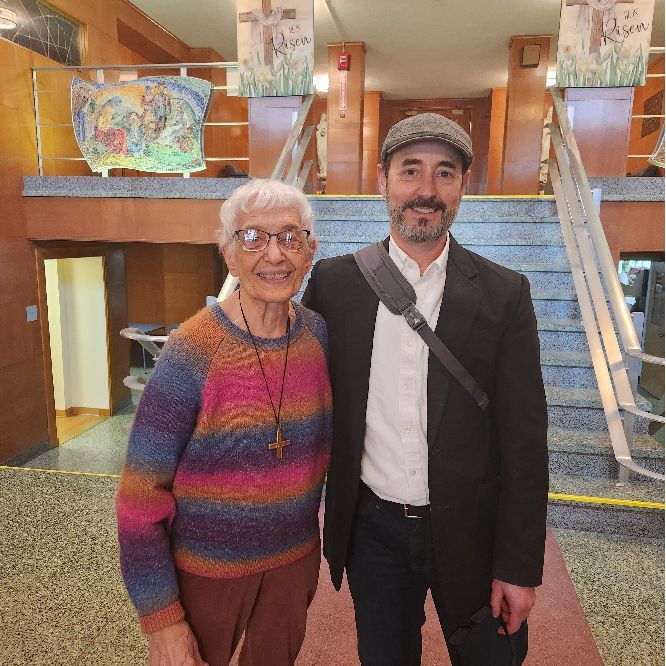
Sister Isabelle Izika, SNDdeN at COP30
The Role of the Churches Before and During Cop30
At the time of COP30 in Belém, Christian churches—Catholic, Protestant, Evangelical, and Orthodox—mobilized strongly to influence the global climate debate. Their engagement on climate issues intensified as the summit approached. They drew on their moral authority and the reach of their networks to highlight the urgency of an ecological transition that is just, demonstrating solidarity, and centered on human dignity.
Before COP30, numerous initiatives were launched to raise awareness about climate challenges among the faithful in countries where the churches are present. In Brazil, for example, the National Conference of Bishops (CNBB) supported campaigns to protect the Amazon, denounced deforestation, and the illegal exploitation of Indigenous lands. Globally, ecumenical movements such as the World Council of Churches and the Laudato Si’ Movement organized webinars, marches, advocacy actions, and public mobilizations to put pressure on political leaders.
Religious leaders emphasized the close link between climate justice and social justice, reminding the world that protecting the Amazon means defending Indigenous peoples, the poor, and global biodiversity. During COP30, the churches maintained a strong presence through interreligious delegations active in both official and parallel spaces of the summit. They consistently reminded decision-makers and the public of the need for profound changes in lifestyles, production, and consumption patterns if climate policies are to be truly effective. In Belém, a space for prayer and dialogue was created to bring together religious leaders, scientists, NGOs, Indigenous representatives, and political actors—fostering dialogue that connected faith, social action, and ecology. Brazilian churches, rooted in communities directly affected by environmental crises, bore witness to the daily realities of climate change.
The churches were not given the opportunity to participate directly in diplomatic negotiations, but they exercised significant moral influence. They continually urged governments to adopt more ambitious commitments and encouraged them to become agents of change. Pope Francis’s teachings in Laudato Si’ and Laudate Deum, as well as the message of Pope Leo XIV, guided the Catholic Church to promote an integral ecology linking environment, economy, and human dignity. Protestant and Evangelical leaders, for their part, stressed the collective responsibility toward creation.
The churches’ presence in Belém clearly demonstrated that the fight against climate change is not limited to political and scientific spheres, but touches the very heart of social life, solidarity, and our shared future. At a time when decisions taken at COP30 will shape the decades to come, the churches remind us that protecting the planet also means protecting humanity.
COP30’s Hopeful Step and its Limits
The 2025 global climate summit took place from November 10–21, 2025 in Belém, Pará, Brazil. The meeting was presented as the “Implementation COP,” with a key objective: to shift momentum from pledges to concrete action in line with what we learned from the first global stocktake of the Paris Agreement. The summit brought together governments, civil society, Indigenous representatives, private-sector actors, and scientists.
Under Brazil’s presidency, COP30 sought to implement a more action-oriented approach. Beyond setting new climate-policy ambitions, the summit aimed to mobilize various stakeholders—governments, cities, business sectors, investors, and non-state actors—through a unified framework called the COP30 Action Agenda.
The Action Agenda is structured around the following themes: mitigation, adaptation, land and biodiversity, sustainable agriculture, infrastructure and resilience, social development, finance, technology, and capacity building.
Major Agreements & Outcomes
At its conclusion, COP30 produced a final package of decisions—commonly referred to as the “Mutirão Decision” (from a Portuguese term meaning collective community effort)—which bundles multiple tracks ranging from climate finance to trade and adaptation.
Among the most important outcomes:
- Increased climate finance for developing countries and adaptation funding: Parties agreed to ramp up support, calling for adaptation finance to be tripled by 2035.
- Formal recognition of “just transition” and associated mechanism: A new instrument—the Belém Action Mechanism for a Global Just Transition (BAM)—was created to embed labor rights, equity, social inclusion, and human rights within the climate transition process.
- Commitment to translate global stocktake findings into practical action: The conference re‑energized efforts to operationalize the first global stocktake via the Action Agenda, with 117 concrete “Plans to Accelerate Solutions” emerging from over 480 existing initiatives.
- Focus on land, forests, nature, and ecosystems: Recognizing the necessary role of forests, biodiversity, and land use, COP30 emphasized ecosystem protection, sustainable agriculture, and nature-based solutions as essential components of global climate strategy.
At this summit, more Indigenous peoples participated than at any previous COP. Their strong presence highlighted the importance of Indigenous rights, traditional lands, and cultural knowledge in the fight against climate change.
Despite these advances, COP30 also faced significant setbacks and criticism:
- No binding fossil-fuel phase-out roadmap: Although many countries pushed for language phasing out fossil fuel use, the final agreement avoided explicit commitments to cease production or consumption.
- Weak or inadequate financing baseline: While the conference called for tripling adaptation finance, the baseline was weak and still far below what vulnerable countries require.
- Non-binding language and voluntary measures: Many components, including the “just transition” and adaptation commitments, remain voluntary and dependent on national follow‑through.
- Continued high emissions: Even with strengthened pledges, global efforts remain insufficient to keep warming below 1.5°C.
COP30 reflects a transitional moment for global climate governance. On one hand, it marks a shift toward implementation, inclusion, social justice, ecosystem protection, and mobilization across sectors. The creation of just‑transition mechanisms and increased adaptation finance may lay groundwork for more equitable climate action.
On the other hand, leaders could not agree to stop using fossil fuels; the promises remain nonbinding, and financing remains too limited. This shows the gap between political willingness and the scale of necessary change. Whether COP30 makes a real difference will depend on future political will and concrete implementation.
How the Global Climate Change Summit (COP30) in Belém, Brazil, is connected to the Sisters of Notre Dame de Namur
Belém, where the Summit was held from Nov. 10–21, is the capital of the State of Pará, Brazil, located in the Amazon region. Geography: Where are SNDdeN in the Amazon Region? Currently, two Notre Dame ministries are in the State of Pará: Anapu (Jane Dwyer, Katy Webster, Maria Oliveira da Silva), and Breves – Marajó (Sandra Araújo dos Santos, Luciane Diniz, Carla Maria Souza de Vasconcelos). Our third ministry is in Oiapoque, in the State of Amapá, also in the Amazon region (Rebeca Spires, Maria de Jesus Borges Costa, and Josineide Maria de Silva). Our central Notre Dame office is in Belém.
How the Spirit and Legacy of our Sister Dorothy Stang Are Alive at This Summit
On the streets of Belém, o povo (the Brazilian people)—thousands of farmers, workers, women, Indigenous tribes, and grassroots communities—marched and protested, demanding respect for the Amazon forest and its peoples, and an end to fossil fuels. Many carried posters of Sister Dorothy, remembering that it is 20 years since she gave her life for the forest and its inhabitants.
During Lent 2025, the Brazilian Church across the whole country held community discussions on Ecologia Integral (Integral Ecology) in the Fraternity Campaign. A video about Dorothy, narrated by our Brazilian sisters, was part of this reflection on how the ecological crisis affects all life on the planet. (Video is on YouTube.)
Marina Silva, Brazil’s Secretary of the Environment, knew Dorothy and described her as follows: “Sister Dorothy’s struggle laid the foundation of what researchers and scientists say today about the possibility of making a new cycle of prosperity based on biodiversity in the Amazon. She dedicated her life to love, justice, and peace.”
Marina Silva also called for an ethical shift as COP30 faces resistance from fossil‑fuel interests: “This is an ethical question. Ethics impels us to convey this sense of urgency. More people have died due to climate change in two years than from COVID‑19. And CO₂ emissions from fossil fuels now cause more deaths than wars. Five hundred thousand people die each year from heat waves.”
To Ponder:
We remember that Dorothy Stang gave her life to protect the forest, its people, and all its inhabitants—and to save the planet. Here and now, how are we raising our voices and actions against fossil fuels? As an international congregation?
Questions for reflection:
- Do people know about climate change where you live, or are they only stunned by the changes they experience?
• What actions have you taken about climate change where you live?
See: Fraternity Campaign video
This report is from the SNDdeN@UN newsletter by Sister Isabelle Izika, SNDdeN, the Sisters’ representative at the United Nations. The Sisters of Notre Dame de Namur has been an accredited non-governmental organization (NGO) at the United Nations since 2001.
To read the entire newsletter, click SNDdeN@UN NEWSLETTER NOVEMBER 2025 2-1.