175 Years in New England: An Enduring Legacy of Goodness
June 8, 2024
Home → About Us → U.S. East-West Province → 175 Years in New England
By Sister Mary Mulligan, SNDdeN
“Let the trumpet sound to announce the year… Cry Jubilee!” — Song from the Sonaike Family.
This line begins and ends a song celebrating jubilee time and proclaims 2024 as the 175th anniversary of the arrival in the young Diocese of Boston of the Sisters of Notre Dame de Namur on Nov. 12, 1849.
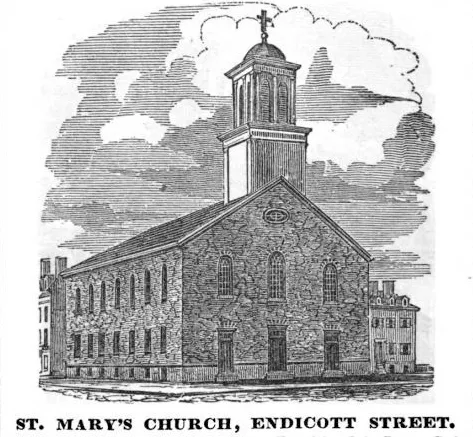
Fearlessly, the Sisters of Notre Dame de Namur arrived in Cincinnati, Ohio, in 1840. While there, they received an invitation from Bishop John Fitzpatrick, extended by Father John McElroy, SJ, the pastor of St. Mary Parish and founder of Boston College, to come to Boston to educate the tremendous influx of European immigrants. The first three Sisters of Notre Dame de Namur arrived on Nov. 12, 1849, and settled into the North End.
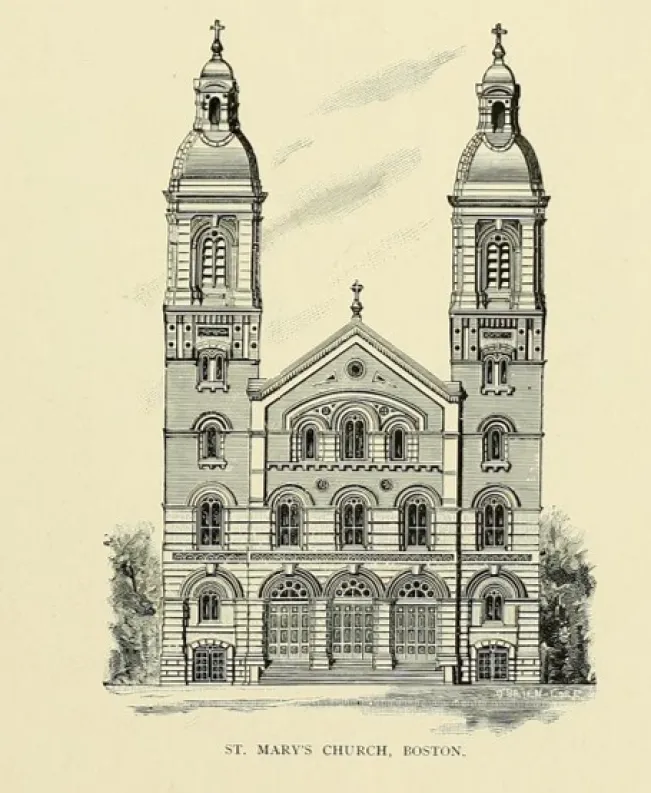
St. Mary’s Church in Boston
The needs were overwhelming in the decades before and after the Civil War. People whose Catholic ancestors lived in the Boston area in the mid-19th century probably received their first Catholic education from these Sisters of Notre Dame de Namur, who welcomed the immigrants and the working-class poor.
As the first women religious in Boston after the burning of the Ursuline school and convent in 1834, they were pioneers in dealing with primitive living and teaching accommodations and with virulent anti-Catholic violence. Their educational ministries began in ramshackle buildings that soon became untenable when the number of pupils increased by the hundreds.
In the years surrounding the Civil War, the Sisters of Notre Dame de Namur witnessed tremendous growth as businesses developed the Boston neighborhoods into commercial and industrial centers. The air and noise pollution became significant health issues, and the land grab stifled opportunities to expand the school buildings. Partnering with countless pastors, the Sisters of Notre Dame de Namur opened educational ministries in the North End, West End, South Boston, East Boston, Dorchester, Roxbury, Brighton, and the Back Bay areas of Boston.
Through their tireless labors, they founded Catholic education in Boston through several “firsts” including:
- Opening the first parochial school in Boston, St. Mary in the North End, which at the time, 1849, was the only Catholic school in Massachusetts, followed by St. Patrick School in Lowell in 1852.
- Opening the first surviving academy in Boston: Boston Academy of Notre Dame, 1853.
- Organizing the first Sunday schools and sodalities in multiple neighborhoods.
- Opening the first Catholic women’s college in New England: Emmanuel College, 1919.
- Opening the first night schools for girls obliged to work during the day. The Sisters of Notre Dame de Namur added an industrial school in 1858, which they kept for 10 years until it proved too difficult to maintain.
Two neighborhoods in Boston stand out as an enduring backbone for them. The long Broadway corridor in South Boston, connecting to Dorchester Avenue, runs through Boston neighborhoods along the Atlantic Ocean. This stretch was fertile ground for the Sisters of Notre Dame de Namur. Sts. Peter and Paul High School in South Boston in 1860 became Archbishop, then Cardinal Cushing High School (CCCH), educating thousands of young women for 132 years. When the archdiocese closed CCCH, the Sisters immediately reworked their educational ministry into The Notre Dame Education Center (NDEC), where they continued to labor for more than 25 years, delivering educational services to the hundreds of new immigrants coming into the area and to those who needed to complete their high school credential. St. Augustine School also served South Boston, St. Mark School, and St. Gregory Elementary and High Schools in Dorchester augmented their outreach.
Two ministries in this area continue to serve people needing extra assistance with their lives. Project Care and Concern in Dorchester provides pastoral services through food programs, summer camps, a thrift store, and senior citizen and family outreach.
Responding to the signs of the times during the busing era in the 1970s, two Sisters of Notre Dame de Namur initiated Julie’s Family Learning Program in South Boston, an education ministry for mothers with young children on public assistance; the children in this program attend a Montessori School. Other Montessori Schools in Milton and Wenham supported Julie’s and the Montessori School at Columbia Point in Dorchester. On Apr. 4, 2024, Julie’s Family Learning Program will celebrate 50 years of continuous service.
The tremendous momentum of the expanding population pulled the Sisters of Notre Dame de Namur into founding schools in many of the mill towns and cities where the immigrants were settling in Massachusetts: Andover, Beverly, Beverly Farms, North Beverly, Cambridge, Danvers, Hudson, Lawrence, Leominster, Lowell, Lynn, Marblehead, Maynard, Methuen, Milton, Needham, North Dartmouth, North Weymouth, Peabody, Salem, Shrewsbury, Somerville, Tyngsborough, Waltham, West Newton, Wenham, Woburn, Worcester, then west to Springfield and Chicopee, south to Rhode Island and Connecticut, north to New Hampshire with Maine providing both a vacation house and pastoral opportunities. Fifteen other flourishing foundations that the Sisters of Notre Dame de Namur initiated and nurtured into development were transferred to other congregations when more religious arrived.
Sister Mary (Anna Marie) Mulligan, SNDdeN, was a Sister of Notre Dame de Namur for more than 75 years. She completed this last labor of love before her unexpected death on Sept. 27, 2023.
This story also appeared in the Boston Pilot.